Put the anchors on the map
Mark the airport terminal, accommodation, meeting address and any onward destination. Then consider the order of travel: arrival, work, overnight and departure. A hotel near the airport may be the natural choice when a flight arrives late and leaves early, or when the next day’s work is in an airport business district. It may be less convenient if the programme is centred on offices or restaurants in the city.
Do not let the airport’s name stand in for a route plan. Heathrow and Gatwick serve different parts of the London region; Frankfurt, Schiphol, Charles de Gaulle, Munich, Zurich, Copenhagen and Dublin each have their own transport patterns. Check how you will reach the actual meeting location, including changes and the first and last mile.
Compare terminal and transport access
Terminal-adjacent accommodation may reduce transfers, particularly for early departures or late arrivals. Verify the walking route from the relevant terminal and whether luggage, mobility needs or terminal changes alter the plan. An airport hotel close to a railway station can open up a wider network, but the station’s destination, interchange requirements and access route matter more than the word “rail” in a listing.
Public transport may be convenient for city-centre meetings, while taxi or car access can be more direct to a business park or venue outside the network. If a shuttle is part of the plan, check its pickup point, hours, reservation process and whether it operates when your flight or meeting ends. Avoid building a tight schedule around an unconfirmed service.
Match the hotel to the meeting
Measure the journey to the office, business park, conference centre or exhibition venue—not simply to the airport. A meeting location near the airport can still be separated from terminal hotels by roads or limited pedestrian connections. Conversely, a city-centre stay may put several urban appointments within reach and save repeated travel across town. Restaurants and workspaces also deserve attention: consider what is accessible after a long day and whether the accommodation itself offers suitable facilities.
Workspace needs vary. A desk, reliable internet and charging may be essential for preparing a presentation or joining a call. A meeting room can help with private discussions, but availability and conditions need confirmation. Breakfast timing and dining access should match the planned day; an early flight may depart before regular breakfast service begins.
Consider comfort, accessibility and length
Noise sensitivity, sleep and room position can influence how useful an overnight feels. Airport districts have activity at different hours, and a request for a quiet room may not be guaranteed. Read the accommodation’s description carefully and ask questions about sound, room access and any specific need rather than assuming all rooms are alike.
Check accessibility as a complete journey: transport, route to the entrance, steps, lifts, room layout and facilities. If particular arrangements are required, ask the provider for clear information before booking. Length of stay changes the balance too. For one night, reducing a difficult transfer may matter most. For several nights, dining, workspace and city connections can become more significant than immediate terminal proximity.
Airport hotel or city-centre hotel?
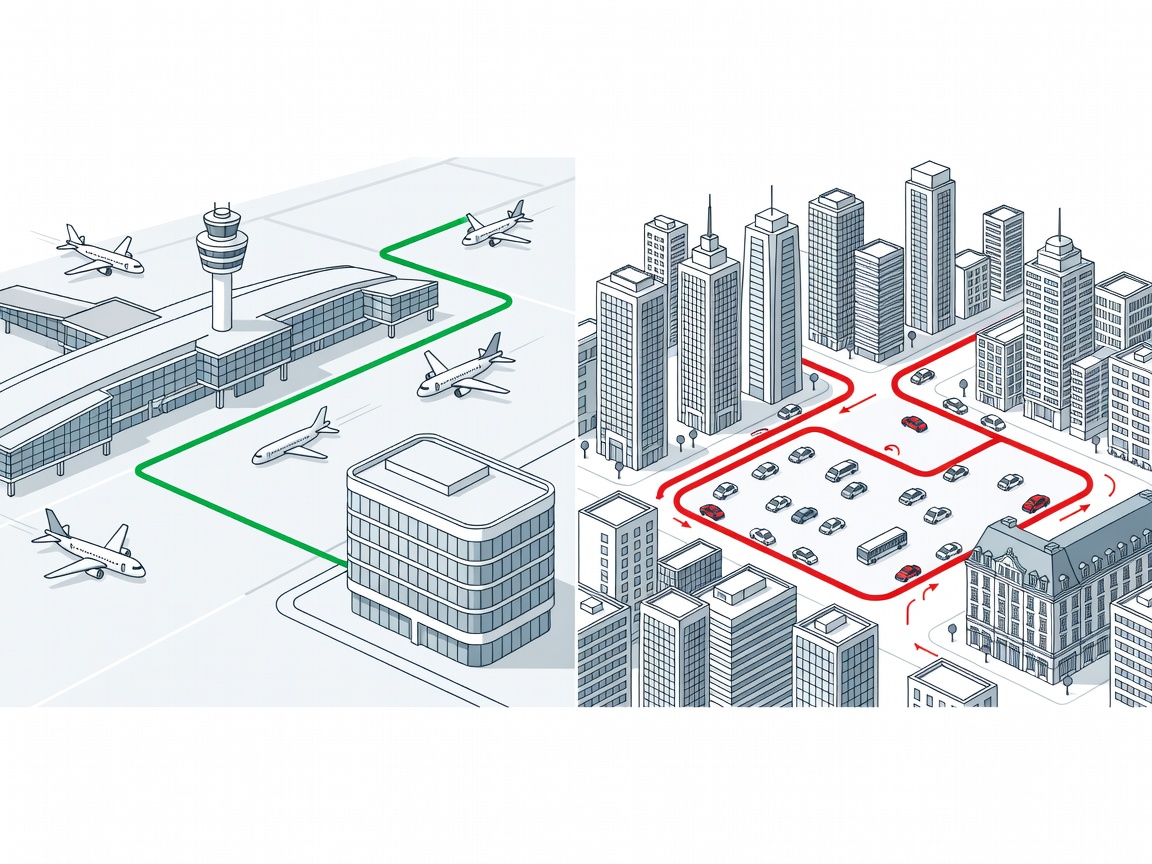
An airport stay often makes more sense when the trip is built around flight times, an airport-side meeting, a conference nearby or a short overnight between travel legs. A city-centre hotel may be more efficient when most appointments, evening plans and onward movements are urban. For a mixed itinerary, compare the total sequence: travelling to a central hotel after arrival, returning to the airport district for work, then heading back to the terminal can create unnecessary backtracking.
Use Airport Hotel Location to examine proximity and connections, and Business Hotel Features to prioritise facilities. The short-stay guide covers timing, luggage and early or late travel; Airport Business Hubs explains how commercial environments differ.